
Yes, professional countertop repair can extend the life of natural stone when the damage is repairable and the underlying cause is addressed. Chips, localized cracks, worn edges, scratches, seam problems, and some sink-area damage do not automatically mean a granite or marble countertop needs to be replaced.
For homeowners considering countertop repair in Charleston, SC, the key question is not simply whether the damage can be filled. We need to understand why it happened, whether the slab is still stable, and what must be corrected so the repair has a reasonable chance of lasting.
At The Art of Stone, we focus on two things: fixing what is damaged and protecting the stone that is still worth preserving.

What Types of Countertop Damage Can Usually Be Repaired?
Many localized forms of damage can be repaired when the surrounding stone remains structurally sound. The exact method depends on the material, location, depth, finish, and cause of the problem.
Common repairable issues include:
- Small edge chips
- Broken corners
- Localized cracks
- Damage around sink cutouts
- Minor seam deterioration
- Surface scratches
- Marble etching
- Small pits or voids
- Worn or uneven finish
A repair becomes more complicated when damage is widespread or caused by continuing movement underneath the slab. In those cases, restoring the visible surface without fixing the source may only provide a temporary result.
Why Does Finding the Cause Matter Before Repair?
Finding the cause matters because natural stone usually does not fail at random. A crack may result from impact, cabinet movement, inadequate support, stress around a sink cutout, or movement in the structure beneath the countertop.
If we simply fill a crack while the cabinet continues to move, the repaired line may reopen. The same is true when a weak overhang or unsupported section continues to flex.
This is one of the biggest differences between a cosmetic patch and professional countertop repair in Charleston, SC. We evaluate the surrounding installation, not just the visible line.
Can a Cracked Granite Countertop Be Saved?
Yes, some cracked granite countertops can be repaired rather than replaced. The best candidates are localized cracks where the slab is stable and the cause can be controlled.
Cracks near sinks and cooktops deserve extra attention because cutouts leave narrower sections of stone. These areas can experience stress from support issues, impact, or movement.
A crack that continues to widen or crosses a poorly supported section may indicate a more serious problem. In that situation, repair should not begin until the support is evaluated.
Can Marble Countertops Be Repaired Too?
Yes, marble can often be repaired, but its common problems differ from granite. Marble is softer and much more sensitive to acids, so etching, scratches, dull spots, and edge damage are frequent concerns.
Etching is not a stain. It is a chemical change to the marble surface, often caused by lemon juice, vinegar, wine, or acidic cleaners. Honing and polishing can often correct etched or scratched marble, while chips and localized cracks may also be repairable.
How Do Granite and Marble Repairs Differ?
Granite and marble require different repair and refinishing strategies because their physical properties are different.
| Feature | Granite | Marble |
|---|---|---|
| Scratch resistance | High | Moderate |
| Acid sensitivity | Low in most true granites | High |
| Heat resistance | High | High |
| Common damage | Chips, cracks, seam issues | Etching, scratches, chips |
| Typical restoration need | Repair, polishing, sealing when appropriate | Honing, polishing, repair |
Both materials can remain serviceable for many years when damage is addressed correctly and maintenance matches the stone.
Can Countertop Repair Prevent a Small Problem From Getting Worse?
Yes, timely repair can sometimes prevent localized damage from becoming more extensive. A small chip at an exposed edge may grow with repeated impacts, while an unstable crack can spread if the source of stress remains.
That does not mean every line in stone is damage. Natural stone can contain fissures and mineral lines that are not active structural cracks, so diagnosis comes first.
What Happens During a Professional Stone Repair?
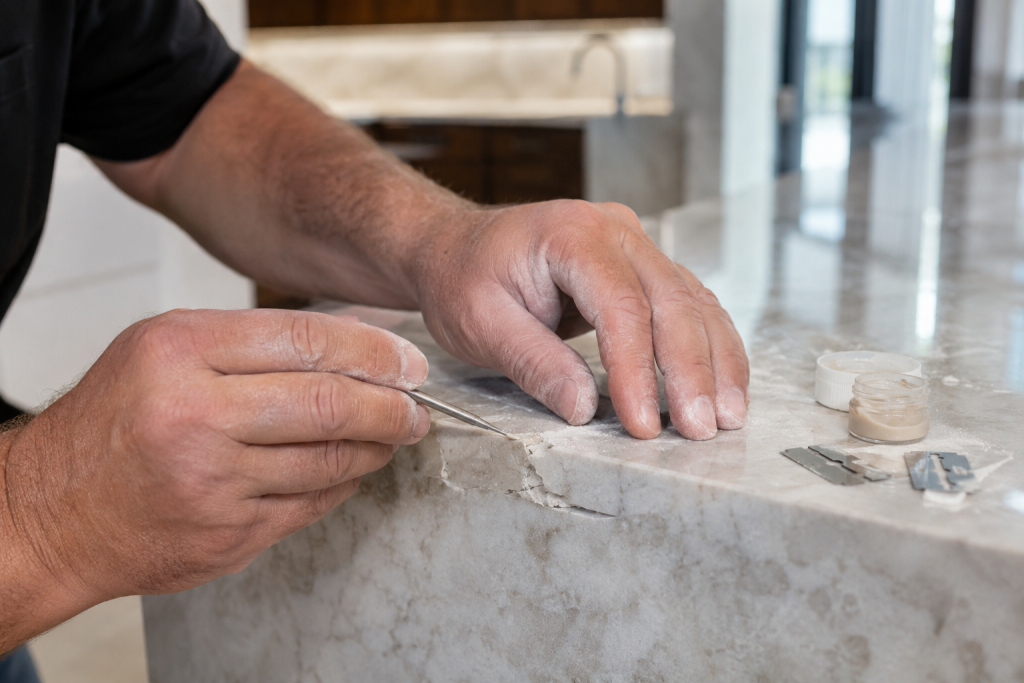
Professional repair begins with inspection. The sequence changes depending on the problem.
A typical process may include:
- Identifying the stone and finish.
- Evaluating the damaged area.
- Checking for movement or inadequate support.
- Cleaning and preparing the repair area.
- Filling, bonding, or rebuilding the damaged section.
- Shaping and color-matching the repair.
- Honing or polishing the surface to blend the finish.
- Sealing the stone when appropriate.
At The Art of Stone, we adjust the repair method to the material and damage rather than using one standard filler for every countertop.
Can Sink-Area Damage Be Repaired?
Often, yes. Chips and localized cracks around a sink cutout can sometimes be repaired, but the sink area is one of the places where we look carefully for underlying stress.
The stone is narrower around the opening, and undermount sinks also depend on proper support. If the cabinet, sink, or countertop has movement, we want to understand that before completing the visible repair.
For homeowners seeking countertop repair in Charleston, SC, sink-area damage is a good example of why diagnosis matters as much as the repair material itself.
Can Countertop Seams Be Repaired?
Yes, some countertop seams can be cleaned, refilled, color-matched, or adjusted. However, a seam that repeatedly opens may indicate movement in the cabinets or countertop sections.
A good repair should address both appearance and cause. Replacing seam filler alone may not be enough if the two pieces continue to shift.
Does Repair Extend the Life of an Older Countertop?
It can. Natural stone does not need to look new to remain worth preserving, and localized wear does not automatically mean the slab has reached the end of its useful life.
Repair can extend service life when the stone remains stable and the damage is limited. It is especially practical when replacement would mean removing a large amount of otherwise sound granite or marble.
When Is Replacement Better Than Repair?
Replacement is usually the better option when the slab has extensive structural damage, widespread movement, severe breakage, or a layout that no longer works for the kitchen. Repair should not be used to disguise a countertop that is fundamentally unstable.
Replacement may make more sense when there are:
- Multiple active cracks
- Severe structural movement
- Large unsupported sections
- Extensive breakage around several cutouts
- Major layout changes that make the existing slab unusable
The goal is not to repair everything at any cost. The goal is to preserve stone when repair is technically sensible.
How Much Does Countertop Repair or Restoration Cost?
The price depends on the material, damage, access, repair method, finish, and amount of refinishing required. Our countertop restoration services start from $450, but a repair quote depends on the actual condition of the surface.
At The Art of Stone, we do not apply the $450 starting point to every possible stone repair. A small chip, a structural crack, and a full countertop refinishing project are very different scopes.
For countertop repair in Charleston, SC, an inspection helps determine whether the job requires localized repair, refinishing, sealing, or a combination of services.
Does Sealing Help a Repaired Countertop Last Longer?
Sometimes, but sealing is not a structural repair. A penetrating sealer can reduce the rate at which certain liquids absorb into porous stone, but it does not reinforce cracks, prevent movement, or stop marble from etching.
We recommend sealing only when the particular stone benefits from it. Granite varies in porosity, and marble sealing can help with staining while still offering no protection from acidic etching.
How Should You Care for Stone After Repair?
Use cleaning methods appropriate for the material and avoid unnecessary stress on repaired areas. Proper care can help preserve both the repair and the surrounding stone.
We generally recommend:
- Use products appropriate for natural stone
- Wipe spills promptly
- Avoid acidic cleaners on marble
- Use trivets under very hot cookware
- Use cutting boards
- Watch repaired cracks for renewed movement
- Address leaks or cabinet movement promptly
Why Does Technical Experience Matter in Countertop Repair?
Experience matters because stone repair combines material identification, structural judgment, color matching, finish matching, and surface restoration. A repair that looks good can still fail if the source of the crack remains.
Ivan has authored professional materials, developed technical methods, and participated as a speaker at industry exhibitions, workshops, and educational events. His educational work has included the College of Charleston and the American College of the Building Arts (ACBA), and his natural stone expertise has received federal-level recognition in the United States under the extraordinary-ability standard.
That technical background informs how The Art of Stone approaches repair and restoration rather than treating every chip or crack as the same problem.

FAQ
Can a cracked natural stone countertop be repaired?
Yes, many localized cracks can be repaired if the slab is stable and the cause of the damage can be addressed.
Is a natural fissure the same as a crack?
No. A fissure is a natural feature within stone, while a crack usually indicates separation or damage.
Can a chipped granite edge be repaired?
Often, yes. Small chips can frequently be filled, shaped, color-matched, and refinished.
Will countertop repair be invisible?
Some repairs can blend very well, but complete invisibility cannot be guaranteed. Stone pattern, color, finish, and damage size affect the result.
Can marble etching be repaired?
Yes. Etching can often be corrected through honing and polishing because it affects the surface finish.
How much does countertop restoration cost?
Our countertop restoration services start from $450. Final pricing depends on the material, damage, size, finish, and required process.
Is countertop repair in Charleston, SC better than replacement?
It can be when the slab is structurally sound and the damage is localized. Replacement is more appropriate when the countertop is unstable, extensively broken, or no longer suitable for the space.
Natural Stone Countertop Repair in Charleston, SC
The Art of Stone serves Charleston, SC and nearby communities with professional stone and tile restoration, repair, and maintenance. Our services include Countertops & Vanities, Showers & Tile, Floors, Stone & Tile Repairs, Outdoor Stone & Pool Areas, and Stone & Tile Maintenance.
If you are considering countertop repair in Charleston, SC, we can evaluate the damage, identify the likely cause, and determine whether repair, honing, polishing, sealing, or replacement is the better path. Call 843-609-3536 to discuss the condition of your natural stone countertop.