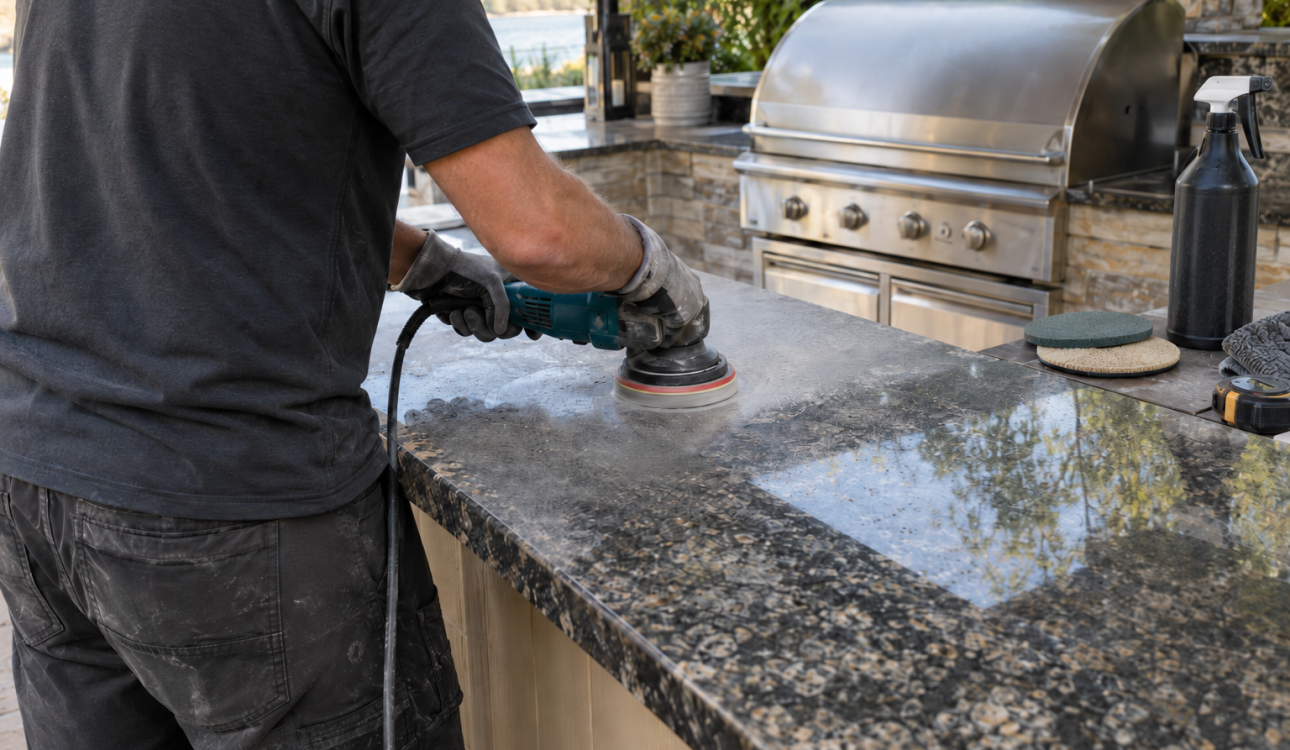
Outdoor stone usually deteriorates faster because it is exposed to water, sunlight, temperature changes, salts, biological growth, and repeated wet-dry cycles. Indoor stone stays in a more controlled environment, so the surface and materials beneath it generally experience less stress.
For homeowners considering outdoor stone restoration in Charleston, SC, the first step is identifying what is actually causing the deterioration. At The Art of Stone, we do not assume that every faded, rough, or discolored surface simply needs cleaning. Outdoor stone may need cleaning, repair, surface restoration, drainage correction, or sealing depending on the cause.
Why Does Water Cause So Many Outdoor Stone Problems?
Water is one of the biggest factors because porous stone can absorb moisture through the surface, joints, edges, or substrate. Repeated wetting and drying can move dissolved minerals and salts through the stone and contribute to discoloration, efflorescence, surface erosion, and joint deterioration.
A patio that stays damp long after surrounding areas have dried deserves closer inspection. The issue may involve poor drainage, low spots, irrigation, clogged joints, or moisture moving upward from below.
How Does Outdoor Exposure Differ From Indoor Conditions?
Outdoor stone faces several stressors at the same time. Indoor countertops and floors may see spills and foot traffic, but they are usually protected from direct rain, strong sunlight, standing water, and major environmental changes.
| Condition | Outdoor Stone | Indoor Stone |
|---|---|---|
| Rain and standing water | Frequent exposure possible | Usually limited |
| UV exposure | Can be continuous | Minimal |
| Temperature change | Daily and seasonal cycles | Relatively stable |
| Biological growth | More likely in damp areas | Less common |
| Salt and mineral deposits | More likely | Usually lower |
| Maintenance demands | Exposure-dependent | More predictable |
For outdoor stone restoration in Charleston, SC, this exposure history often tells us more than the age of the stone alone.
Does Sunlight Damage Natural Stone?
Sunlight can change the appearance of an outdoor installation, especially when stone, fillers, coatings, sealers, or repair materials react differently to UV exposure. Some surfaces gradually look lighter, drier, or less uniform.
A failed coating is different from natural weathering, so the treatment should be based on what has actually changed.
Why Does Outdoor Stone Become Rough or Chalky?
A rough or chalky surface can result from weathering, chemical attack, surface erosion, inappropriate cleaning, or deterioration of the stone itself. Softer calcite-based stones such as limestone, travertine, and marble are especially sensitive to acidic products.
Pressure washing can also worsen a weakened surface when excessive pressure removes softer material or erodes joints. At The Art of Stone, we determine whether deep cleaning is enough or whether controlled honing or another restoration method is needed.
What Is Spalling?
Spalling is the breaking, flaking, or loss of material from the stone surface. It is more serious than ordinary dirt or fading because part of the stone is physically deteriorating.
Moisture movement, salts, repeated exposure, stone selection, installation conditions, or substrate problems can contribute. Sealing over a spalling surface does not rebuild damaged material or correct the source.
Why Does Outdoor Stone Turn White?
White deposits are often caused by mineral or salt movement, but not every white mark is the same. Efflorescence, hard-water deposits, sealer residue, and surface deterioration can all create pale or chalky areas.
Efflorescence occurs when water carries soluble salts toward the surface and then evaporates. Removing the visible deposit without addressing ongoing moisture can result in the white material returning.
This is one reason outdoor stone restoration in Charleston, SC should begin with diagnosis rather than choosing a cleaner based only on appearance.
Can Salt Damage Outdoor Natural Stone?
Yes. Salts can move into porous materials with water and crystallize as moisture evaporates. Repeated crystallization can place stress within pores and contribute to deterioration in vulnerable stone.
Salt can come from soil, masonry materials, water, pool environments, or some cleaning products.
Does Poor Drainage Make Stone Deteriorate Faster?
Yes. Poor drainage keeps stone and joints wet longer and increases the chance of moisture-related damage.
A restoration may improve the surface, but it cannot compensate indefinitely for water that continually collects in the same area. We look for standing water, poor slope, blocked drainage paths, and failed joints before treating recurring surface problems.
Why Do Algae and Biological Growth Keep Returning?
They often return because the environment remains favorable for growth. Shade, moisture, poor airflow, landscaping, irrigation, and a surface that stays damp can all contribute.
Cleaning removes contamination, but it does not automatically change those conditions. For outdoor stone restoration in Charleston, SC, long-term improvement may require both surface treatment and better moisture management.
Can Pool Water and Pool Chemicals Affect Stone?
Yes. Pool decks and coping experience water, evaporation, minerals, chemicals, sunscreen, body oils, and foot traffic. These conditions can create deposits, roughness, staining, joint deterioration, or uneven appearance.
The correct treatment depends on the stone. Limestone, travertine, marble, granite, and other materials do not react the same way to acids, alkaline cleaners, or mechanical refinishing.
We also consider slip resistance. A glossy finish that makes sense indoors may be inappropriate for a wet pool surround.
Should Outdoor Stone Be Polished?
Not always. Outdoor walking surfaces often perform better with a honed, textured, or naturally slip-resistant finish rather than a high polish.
Honing may improve certain forms of uneven wear, but grinding or honing will not correct loose substrate, drainage failure, unstable pavers, or structural movement.
When Is Cleaning Enough?
Cleaning is enough when the main problem is removable contamination and the underlying finish remains sound. Dirt, organic buildup, and certain deposits may respond well to stone-appropriate professional cleaning.
More involved restoration may be needed for:
- Etching or chemical damage
- Uneven wear
- Spalling or pitting
- Failed repairs or joints
- Persistent mineral deposits
- Cracks or loose pieces
- Failed coatings or sealer residue
The treatment should match the failure. More aggressive work is not automatically better.
Can Outdoor Stone Be Restored Instead of Replaced?
Often, yes, if the stone remains structurally serviceable and the source of deterioration can be managed. Cleaning, honing, repairs, filling, joint work, and sealing can extend the useful life of many installations.
Replacement may be more practical when pieces are severely fractured, the substrate is unstable, the installation has widespread movement, or too much sound material has been lost.
At The Art of Stone, our goal is to preserve existing stone when it is technically reasonable.
Should Outdoor Stone Be Sealed After Restoration?
Sometimes. A penetrating sealer can reduce liquid absorption in porous stone, but sealing should be based on the material, exposure, moisture conditions, and product compatibility.
Sealer does not make stone waterproof. It cannot correct poor drainage, stop moisture entering from below, repair cracks, or prevent every stain.
The surface also needs to be properly prepared and sufficiently dry before treatment.
Why Can Outdoor Sealer Turn Hazy or Fail?
Haze or premature failure can occur when the wrong product is used, too much material remains on the surface, moisture is present, the stone is not receptive to the treatment, or preparation is inadequate.
Topical coatings and penetrating sealers behave differently. For outdoor stone restoration in Charleston, SC, we first determine what is already on the stone before adding another treatment.
How Do Different Natural Stones Perform Outdoors?
They differ in porosity, mineral composition, chemical sensitivity, texture, and weathering behavior.
| Material | Outdoor Durability | Acid Sensitivity | Common Concern | Sealing |
|---|---|---|---|---|
| Granite | Generally high | Relatively low | Deposits, staining, joint wear | Depends on absorption |
| Limestone | Varies | High | Erosion, etching, biological growth | Often beneficial when appropriate |
| Travertine | Varies | High | Voids, deposits, joint issues | Often considered |
| Marble | Varies by application | High | Etching, weathering, finish loss | Based on absorption and exposure |
These are general characteristics. We still evaluate the specific installation because stones within the same category can perform differently.
What Is the Preserve Package?
The Preserve Package is a separate budget-friendly restoration option starting at $1,100 for qualifying stone and tile projects. It is not a universal price for patios, pool decks, or other exterior restoration.
The package includes:
- Professional deep cleaning of walls and floor
- Premium European penetrating sealer
- Cosmetic grout touch-ups, up to 10 linear feet
The grout touch-ups improve appearance only and do not replace full regrouting when joints have widespread failure.
Why Does Expert Diagnosis Matter With Exterior Stone?
Outdoor deterioration often has several overlapping causes, so treating only the visible symptom can lead to repeat problems. A white deposit may involve moisture and salts, while a rough surface may result from weathering or chemical damage.
Ivan has authored professional articles and technical materials, developed his own methods, and participated as a speaker in professional exhibitions, workshops, and educational events. His educational work has included the College of Charleston and the American College of the Building Arts (ACBA), and he has been involved with professional associations.
His natural stone expertise has also received federal-level recognition in the United States under the extraordinary-ability standard. That background informs the diagnostic approach we use at The Art of Stone.
FAQ
Why does outdoor stone weather faster than indoor stone?
Outdoor stone is exposed to water, sunlight, temperature changes, contaminants, salts, and biological growth that indoor stone usually avoids.
Can pressure washing damage natural stone?
Yes. Excessive pressure can erode softer stone, damage joints, and worsen a weakened surface.
Does sealer make outdoor stone waterproof?
No. Penetrating sealers can reduce absorption but do not function as waterproofing systems.
Can efflorescence come back after cleaning?
Yes. It can return if moisture continues carrying soluble salts through the stone or surrounding materials.
Should a stone pool deck be polished?
Usually not to a high gloss. Wet walking surfaces need appropriate slip resistance.
Can spalling stone be restored?
Sometimes. Minor deterioration may be repairable, but severe material loss or underlying installation problems can make replacement more appropriate.
Should outdoor stone be sealed immediately after cleaning?
Not automatically. The stone needs to be assessed, properly prepared, and sufficiently dry for the selected product.
Outdoor Stone Restoration in Charleston, SC
The Art of Stone serves Charleston, SC and nearby communities with restoration, repair, and maintenance for outdoor stone, pool areas, patios, floors, countertops and vanities, showers, and tile. Our work can include professional cleaning, honing, polishing where appropriate, repairs, filling, and sealing based on the actual material and condition.
If you need outdoor stone restoration in Charleston, SC, we can evaluate moisture, drainage, deposits, weathering, surface deterioration, previous treatments, and repair needs before choosing a restoration method. Call 843-609-3536 to discuss the condition of your exterior stone.